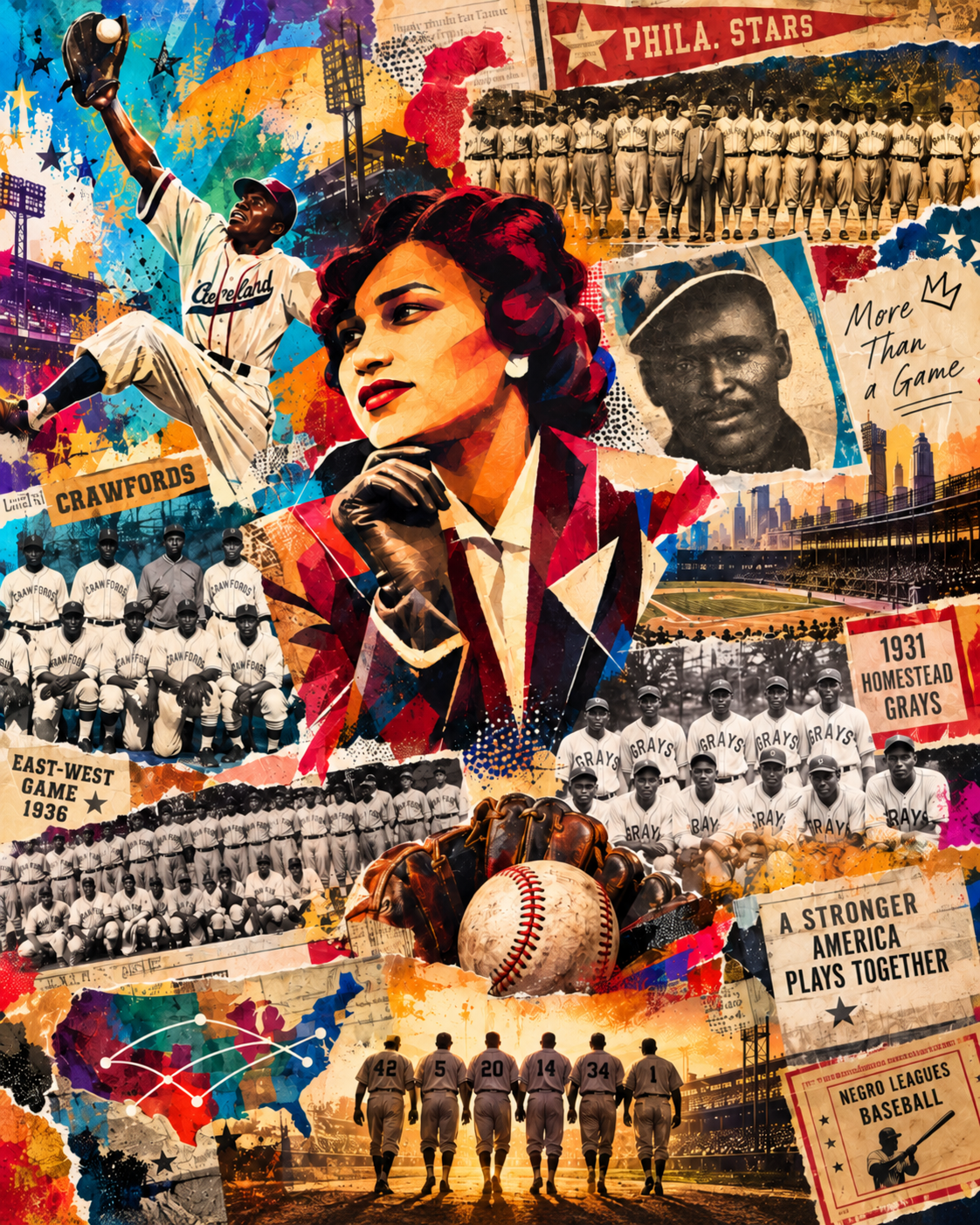
In 1946, the Newark Eagles defeated the Kansas City Monarchs in a seven-game Negro World Series, giving Effa and Abe Manley the greatest season their franchise had ever known. Larry Doby was there. Monte Irvin was there. Leon Day was there. Biz Mackey managed the club. Effa Manley could also see where baseball was going. Jackie Robinson had spent that same summer with the Montreal Royals, one level below the Brooklyn Dodgers. Branch Rickey’s experiment was no longer theoretical. Robinson had excelled, and the question was no longer whether a Black player could compete in Organized Baseball. The question was what would happen when Major League Baseball realized how many others could. In reality, Robinson debuted with Brooklyn on April 15, 1947, permanently changing American sports, and Larry Doby followed with Cleveland that summer. More Black stars soon followed them through the door, but the Negro League organizations did not follow. Attendance declined as Black fans increasingly spent money watching Robinson and other Black stars in the Major Leagues. Major League organizations acquired Negro League players, sometimes compensating their clubs and sometimes challenging whether Negro League contracts should be recognized at all. Within a few years, much of the economic structure surrounding Black professional baseball was disappearing. Effa Manley understood the danger before the collapse was complete. She had already fought for Major League clubs to recognize Negro League contracts and compensate Negro League owners, and when Cleveland acquired Larry Doby, she helped establish that Negro League organizations could not simply be treated as warehouses of unclaimed talent. In this timeline, Manley decides compensation is not enough and begins pushing for something far larger: Major League membership for six of Black baseball’s strongest or most strategically important organizations. Her argument is economic as much as moral. If Major League Baseball now accepts that Negro League players are Major League caliber, then Negro League contracts must be legitimate. If those contracts are legitimate, the organizations issuing them must be legitimate, and if some of those organizations are strong enough to compete at baseball’s highest level, integration should not require their extinction. That becomes the foundation of Manley’s proposal. Integration cannot mean that white Major League Baseball receives the players while Black baseball loses the owners, managers, scouts, front offices, stadium workers and businesses that helped produce them.
Effa Manley’s Counterproposal
Jackie Robinson still joins the Brooklyn Dodgers in 1947, and there is no reason to take that accomplishment away from him. He remains the man who breaks the modern Major League color barrier, withstands enormous pressure and demonstrates in front of the country that the arguments used to exclude Black players were indefensible. Robinson’s success, however, creates a second battle. Manley begins organizing Negro League owners before Major League Baseball can dismantle their leagues through a series of individual player acquisitions. Instead of negotiating only over individual contracts, she asks baseball to consider whether integration can occur at the organizational level too. The proposal eventually centers on six clubs: the Newark Eagles, Kansas City Monarchs, Homestead Grays, Birmingham Black Barons, Atlanta Black Crackers and Indianapolis Clowns. The merger is approved during 1947, with all six beginning Major League play in 1948. The selections are not based only on which six teams happen to possess the best rosters. Newark gives the merger Effa Manley, one of Black baseball’s strongest business minds, along with an established foothold in the New York metropolitan market. Kansas City brings perhaps the most recognizable institutional name in Negro League baseball, while Homestead brings one of the most successful organizations Black baseball ever produced. Birmingham brings Rickwood Field, a deeply established baseball culture and access to Alabama, where Black baseball had thrived despite Jim Crow. Indianapolis adds a Midwestern market with a long Black baseball tradition, while Atlanta represents the most ambitious choice. The Black Crackers are not as powerful an institution as Newark, Kansas City or Homestead, but Manley is thinking beyond 1948. Atlanta is growing, strategically located and too important to the future of the South for a national baseball merger to ignore. She does not want six Black clubs concentrated only in cities white baseball already considers comfortable. If this is going to be a national merger, the South has to be involved from the beginning. That decision creates trouble almost as soon as the first schedule is printed.
The Merger Is Not CharityPREMIUM
Continue this timeline
This section is available to Sports Rewritten members. Checking your membership access…
View MembershipTwenty-Two Major League TeamsPREMIUM
Member-only section.
The Rest of Black Baseball Does Not DisappearPREMIUM
Member-only section.
Then Comes the Money FightPREMIUM
Member-only section.
Opening Day, 1948PREMIUM
Member-only section.
White Players Do Not React as One GroupPREMIUM
Member-only section.
Eddie Stanky Walks Into the Other ClubhousePREMIUM
Member-only section.
Birmingham and Atlanta Force Baseball Into the South EarlyPREMIUM
Member-only section.
Baseball Does Not Cure Jim CrowPREMIUM
Member-only section.
The Threats Are RealPREMIUM
Member-only section.
The Umpires Become Effa’s Next FightPREMIUM
Member-only section.
The Black Press Comes With the TeamsPREMIUM
Member-only section.
Newark Gets There FirstPREMIUM
Member-only section.
Birmingham Finds Willie MaysPREMIUM
Member-only section.
The 1954 World Series Belongs to BirminghamPREMIUM
Member-only section.
Willie Mays Never Becomes a GiantPREMIUM
Member-only section.
Kansas City Keeps Ernie BanksPREMIUM
Member-only section.
Indianapolis Keeps Hank AaronPREMIUM
Member-only section.
Satchel Paige Gets the Major League Stage in Kansas CityPREMIUM
Member-only section.
Buck O’Neil’s LegacyPREMIUM
Member-only section.
The Old White Clubs Integrate FasterPREMIUM
Member-only section.
Latin America Arrives Faster TooPREMIUM
Member-only section.
The East-West Game Refuses to DiePREMIUM
Member-only section.
Major League Baseball’s Map ChangesPREMIUM
Member-only section.
New York May Never Get the MetsPREMIUM
Member-only section.
Black Ownership Becomes Generational WealthPREMIUM
Member-only section.
Effa Manley’s LegacyPREMIUM
Member-only section.
The Record Book Looks DifferentPREMIUM
Member-only section.
The Hall of Fame Changes TooPREMIUM
Member-only section.
By the 1960s, Nobody Can Pretend These Teams Are GuestsPREMIUM
Member-only section.
What Effa Manley Actually SavedPREMIUM
Member-only section.
THE DISCUSSION
Comments
No approved comments yet. Start the conversation.